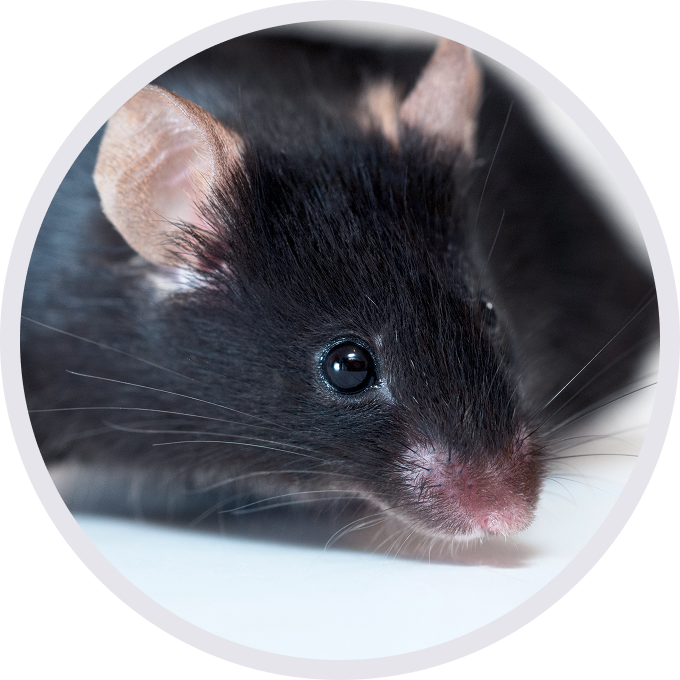
C57BL/6-Apoc3tm1(APOC3)BcgenPcsk9tm2(PCSK9)Bcgen/Bcgen • 113580
| Product name | B-hAPOC3/hPCSK9 plus mice |
|---|---|
| Catalog number | 113580 |
| Strain name | C57BL/6-Apoc3tm1(APOC3)BcgenPcsk9tm2(PCSK9)Bcgen/Bcgen |
| Strain background | C57BL/6 |
| NCBI gene ID | 345,255738 (Human) |
| Aliases | Apo-C3; ApoC-3; APOCIII; FH3; PC9; FHCL3; NARC1; LDLCQ1; NARC-1; HCHOLA3 |

ApoC-III is a critical mediator of atherogenic dyslipidaemia and is directly associated with an increased risk of cardiovascular disease (CVD). Elevated apoC-III levels lead to higher plasma triglycerides and remnant cholesterol by impairing the lipolysis and hepatic clearance of triglyceride-rich lipoproteins (TRLs).
PCSK9 is expressed in the liver, intestine and kidney tissues and escorts specific receptors for lysosomal degradation. It plays a role in cholesterol and fatty acid metabolism. PCSK9 binds to the receptor for LDL, if PCSK9 is blocked, more LDLRs are recycled and are present on the surface of cells to remove LDL-particles from the extracellular fluid.
Targeting strategy:
The exons 2~4 of mouse Apoc3 gene that encode the whole molecule (ATG to STOP codon), including 3’UTR, were replaced by human counterparts in B-hAPOC3 mice. The promoter and 5’UTR region of the mouse gene are retained.
The exons 1-12 of mouse Pcsk9 gene that encode the whole molecule were replaced by human counterparts in B-hPCSK9 mice plus. The promoter, 5’UTR and 3’UTR regions of the mouse gene were replaced by human counterparts.
B-hAPOC3/hPCSK9 plus mice were obtained by crossing B-hAPOC3 mice (112411) with B-hPCSK9 mice plus (112751).
Expression: Human APOC3 was exclusively detectable in B-hAPOC3 mice and B-hAPOC3/hPCSK9 plus mice but not in wild-type mice, and human PCSK9 was exclusively detectable in B-hPCSK9 mice plus and B-hAPOC3/hPCSK9 plus mice but not in wild-type mice.
Application: This product is used for pharmacodynamics and safety evaluation of hypercholesterolemia and other metabolic diseases.

Gene targeting strategy for B-hAPOC3/hPCSK9 plus mice.
B-hAPOC3 mice: the exons 2~4 of mouse Apoc3 gene that encode the whole molecule (ATG to STOP codon), including 3’UTR, were replaced by human counterparts in B-hAPOC3 mice. The promoter and 5’UTR region of the mouse gene are retained.
B-hPCSK9 mice plus: the exons 1-12 of mouse Pcsk9 gene that encode the whole molecule were replaced by human counterparts in B-hPCSK9 mice plus. The promoter, 5’UTR and 3’UTR regions of the mouse gene were replaced by human counterparts.
B-hAPOC3/hPCSK9 plus mice were obtained by crossing B-hAPOC3 mice (112411) with B-hPCSK9 mice plus (112751).


Strain specific APOC3 expression analysis in homozygous humanized B-hAPOC3/hPCSK9 plus mice by ELISA. Serum was collected from wild-type C57BL/6 mice (+/+), homozygous B-hAPOC3 mice (H/H), and homozygous B-hAPOC3/hPCSK9 plus mice (H/H) (female, 5-7 weeks old, n=3). Protein expression level of APOC3 was analyzed by ELISA (Invitrogen, EHAPOC3). Human APOC3 was exclusively detectable in B-hAPOC3 mice and B-hAPOC3/hPCSK9 plus mice but not in wild-type mice. ND= not detectable.

Strain specific PCSK9 expression analysis in homozygous humanized B-hAPOC3/hPCSK9 plus mice by ELISA. Serum was collected from wild-type C57BL/6 mice (+/+), homozygous B-hPCSK9 mice plus (H/H), and homozygous B-hAPOC3/hPCSK9 plus mice (H/H) (female, 5 weeks old, n=3). Protein expression level of PCSK9 was analyzed by ELISA (Proteintech, KE00278). Human PCSK9 was exclusively detectable in B-hPCSK9 mice plus and B-hAPOC3/hPCSK9 plus mice but not in wild-type mice. ND= not detectable.