• 德晋贵宾厅

    B-hCD3EDG/hCD19 ad mice

    C57BL/6-Cd3etm1(CD3E)Bcgen Cd3dtm1(CD3D)BcgenCd3gtm1(CD3G)Bcgen Cd19tm7(CD19)Bcgen/Bcgen • 114862

    B-hCD3EDG/hCD19 ad mice

    Product nameB-hCD3EDG/hCD19 ad mice
    Catalog number114862
    Strain nameC57BL/6-Cd3etm1(CD3E)Bcgen Cd3dtm1(CD3D)BcgenCd3gtm1(CD3G)Bcgen Cd19tm7(CD19)Bcgen/Bcgen
    Strain backgroundC57BL/6
    NCBI gene ID916,915,917,930 (Human)
    AliasesT3E; TCRE; IMD18; CD3epsilon; T3D; IMD19; CD3DELTA; CD3-DELTA; T3G; IMD17; CD3GAMMA; CD3-GAMMA; B4; CVID3

    在此页面上

    • Description
    • Phenotypic analysis
    • Efficacy

    海报

    查看全部

      发表文章

        Description
        • Background: CD3 consists of four protein chains (CD3E, CD3D, CD3G and CD3Z), which are important biological markers on the T cell membrane. CD3 can form a TCR/CD3 complex with the T cell receptor, participating in the regulation of T cell antigen recognition, signal transduction and T cell development. CD19 is a biomarker for normal and neoplastic B cells, as well as follicular dendritic cells. CD19 is critically involved in establishing intrinsic B cell signaling thresholds through modulating both B cell receptor-dependent and independent signaling. CD19 is a cell surface protein expressed on most B-cells, including malignant B-cells in diseases like B-cell leukemia and lymphoma. CD3 and CD19 T-cell engagers (TCEs) are a type of immunotherapy used primarily in the treatment of hematologic cancers, such as B-cell malignancies (e.g., leukemia, lymphoma).
        • Targeting strategy: In B-hCD3EDG/hCD19 ad mice, chimeric human CD3EDG is expressed, while mouse Cd3edg is knocked out. The exons 1-4 of mouse Cd19 gene that encode part of extracellular domain are replaced by human counterparts sequences. The genomic region of mouse Cd19 gene that encodes transmembrane domain and cytoplasmic portion is retained.
        • Model validation: Human CD19 can be detected on B cells from blood of homozygous B-hCD3EDG/hCD19 ad mice, but not in wild-type (WT) mice. The anti-human CD3/CD19 bispecific antibody efficiently depletes B cells in homozygous B-hCD3EDG/hCD19 mice in vivo.
        • Application: This product is used for the pharmacological and safety evaluation of B-cell lymphoma and autoimmune diseases.
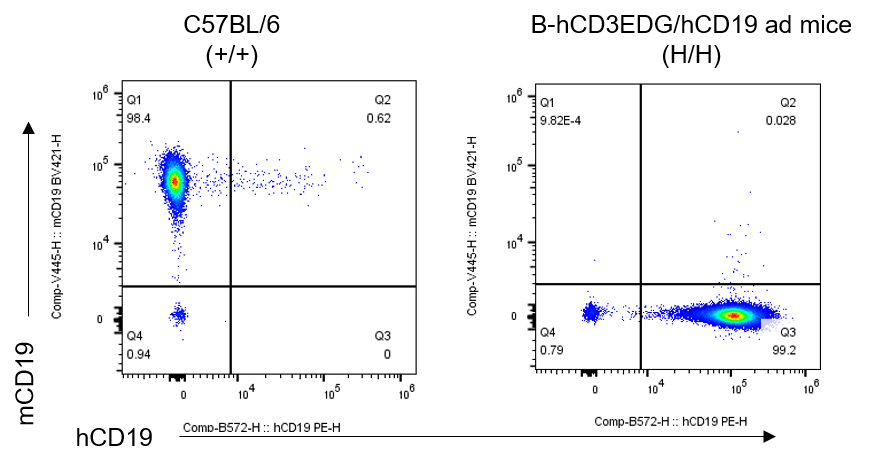
        Protein Expression Analysis of CD19

        Strain specific CD19 expression analysis in wild-type C57BL/6 mice and homozygous B-hCD3EDG/hCD19 ad mice by flow cytometry. Blood cells were collected from wild-type C57BL/6 mice (+/+) and homozygous B-hCD3EDG/hCD19 ad mice (H/H). Protein expression was analyzed with anti-mouse CD19 antibody (Biolegend, 115538) and anti-human CD19 antibody (Biolegend, 302207) by flow cytometry. Human CD19 was exclusively detectable in homozygous B-hCD3EDG/hCD19 ad mice, but not in wild-type C57BL/6 mice. Mouse CD19 was detectable in wild-type C57BL/6 mice.

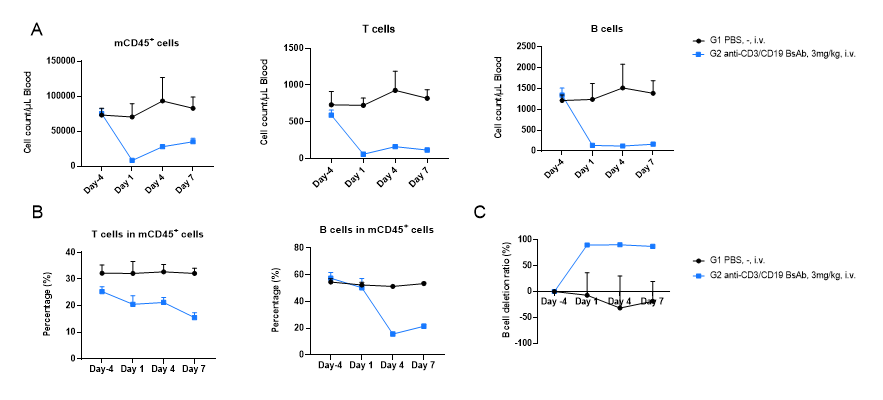
        In vivo B cell Depletion

        In vivo B cell depletion of anti-human CD3/CD19 bispecific antibody (BsAb) in homozygous B-hCD3EDG/hCD19 ad mice. Anti–human CD3/CD19 bispecific antibody and PBS were administered into B-hCD3EDG/hCD19 ad mice (G1:n=2; G2: n=3) through a single dose injection. Blood  were collected at Day-4, Day1, Day4, and Day7 after treatment. The numbers and the frequency of mCD45+ cells, B cells (mB220+) and T cells (mTCRβ+) were determined by flow cytometry. (A) The number of CD45+ cells, B cells and T cells in blood. (B) The proportion of T and B cells in the CD45+Ly6G- cells. (C) B cell depletion ratio. Values are expressed as mean ± SEM.

        * When publishing results obtained using this animal model, please acknowledge the source as follows: The animal model [B-hCD3EDG/hCD19 ad mice] (Cat# 114862) was purchased from Biocytogen.